Author: Florence Tourist Guide

  • Three Hours in Florence: A Walking Route Through the Historic Centre

    Three Hours in Florence: A Walking Route Through the Historic Centre

    Three hours is enough to understand Florence, if the route is built properly. This is the walk we take with guests who have just arrived — it puts the rest of the visit in order.
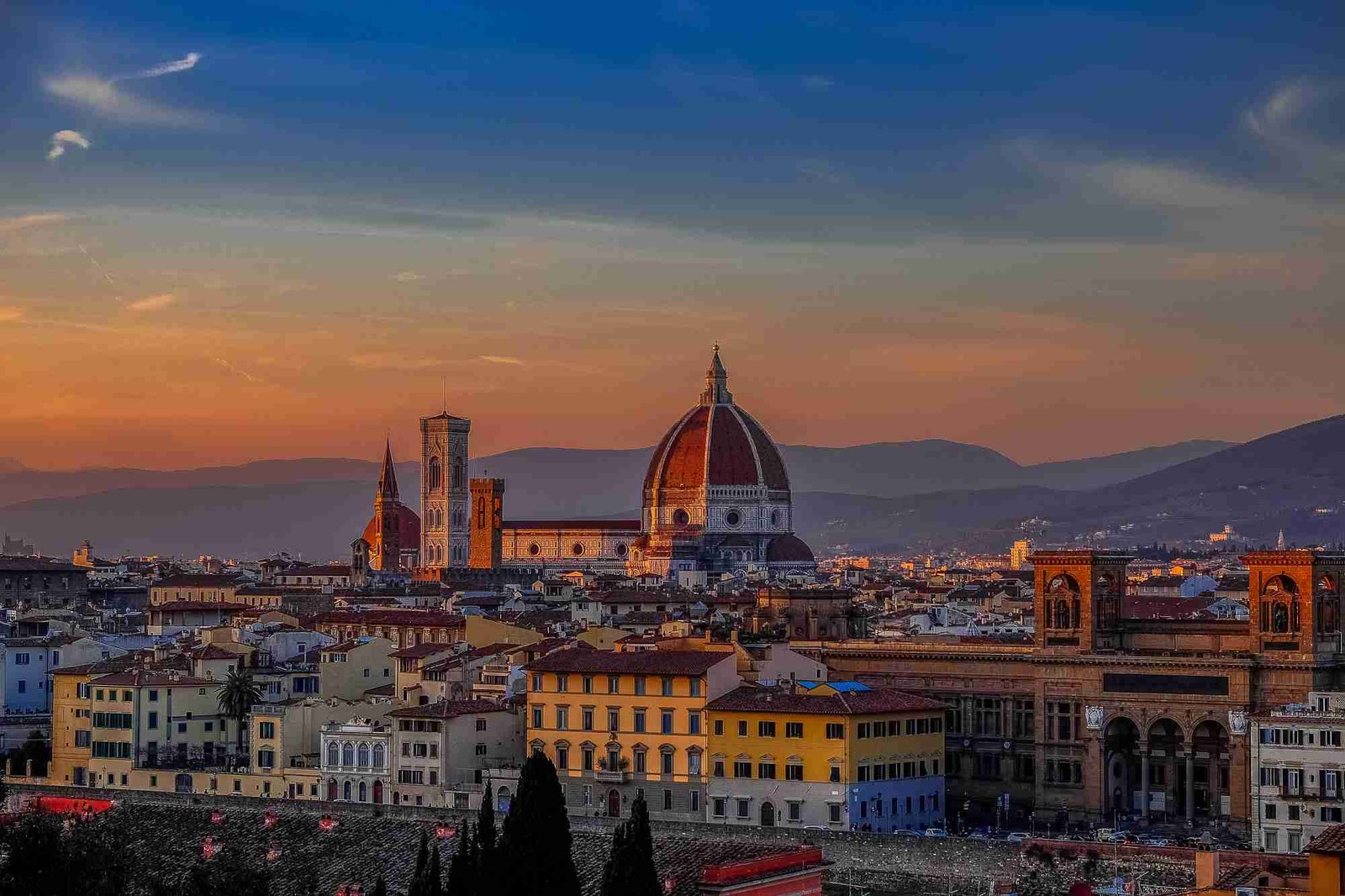
    The dome of Santa Maria del Fiore above the rooftops of Florence

    1. The Duomo and Brunelleschi’s dome

    Begin at Santa Maria del Fiore. The cathedral was left with a hole in its roof for decades because nobody knew how to span it; Brunelleschi won the commission with a double shell built without centring, laid in a herringbone pattern that holds itself up as it rises. Standing in the piazza with that explained is the moment Florence starts to make sense.

    2. The Baptistery doors

    A few steps away, Ghiberti’s east doors — the ones Michelangelo is said to have called the Gates of Paradise. The panels on the building are copies; the originals are indoors, conserved. The competition that awarded the commission in 1401 is usually taken as the starting gun of the Renaissance.

    3. Piazza della Repubblica

    The Roman forum was here, then the medieval market and the Jewish ghetto, then a nineteenth-century clearance that levelled both. The square is the newest thing in the old centre and the best place to explain what the city lost.

    The facade of Santa Maria Novella in Florence

    4. Orsanmichele

    A grain store that became a church, ringed with statues commissioned by the city guilds — Donatello, Ghiberti, Verrocchio, each paid for by the wool merchants, the bankers, the armourers. Florence in one building: commerce, religion and competition in the same wall.

    5. Piazza della Signoria

    The political heart: Palazzo Vecchio, the Loggia dei Lanzi, the copy of the David at the door. We usually finish the first hour here, because everything afterwards refers back to it.

    6. Ponte Vecchio

    Down to the river, over the oldest bridge in the city, with the Vasari Corridor running above the shops. If the light is right we cross to the Oltrarno side and look back.

    Three hours, your pace

    The route above is a spine, not a script. With guests who love architecture we spend longer at Orsanmichele; with families we move faster and stop for gelato; with photographers we start at dawn. Tell us who is coming and what you like, and we will build the walk around it.

    Book your private tour

  • Palazzo Vecchio: Inside the Building Where Florence Was Governed

    Palazzo Vecchio: Inside the Building Where Florence Was Governed

    Palazzo Vecchio is the rarest kind of monument: a building that has never stopped doing its job. It was the seat of Florentine government in 1299 and it is the city hall today, which means you are walking through working rooms rather than a reconstruction.

    Palazzo Vecchio rising above the rooftops of Florence

    The Hall of the Five Hundred

    The room was built in 1494 for the Great Council of the republic, then rebuilt and raised by Vasari for Cosimo I — the ceiling lifted, the walls covered with battle scenes celebrating Florentine victories over Pisa and Siena. It is a deliberate piece of political theatre: a republican hall converted into the audience chamber of a duke.

    In the middle of it stands Michelangelo’s Genius of Victory. And somewhere behind Vasari’s frescoes, according to a theory that has never quite been settled, may lie what remains of Leonardo’s lost Battle of Anghiari.

    The small rooms are the good rooms

    • The Studiolo of Francesco I — a windowless cabinet of curiosities, painted floor to ceiling, built for a Medici prince who preferred alchemy to governing.
    • The Chapel of Eleonora — Bronzino’s frescoes, among the finest surfaces in the building.
    • The Map Room — fifty-three painted maps of the known world as Florence understood it in the 1560s.

    Dante’s death mask

    Kept here, and familiar to readers of Dan Brown’s Inferno, which used the palace as a setting. Whether or not the mask was taken from the poet’s face is disputed. It is still one of the quieter, stranger objects in the building.

    Outside: Piazza della Signoria

    The square is an open-air sculpture gallery and a map of Florentine power. The copy of the David at the palace door, Ammannati’s Neptune fountain, and under the Loggia dei Lanzi, Cellini’s bronze Perseus and Giambologna’s Rape of the Sabines — all placed to be read as statements, not decoration.

    Visiting privately

    Palazzo Vecchio works beautifully as an afternoon, and it is the best possible follow-up to a morning at the Uffizi or the Accademia: the same families, the same rivalries, seen from inside the building where the decisions were made.

    Book your private tour

  • Ponte Vecchio at Dawn: The Quietest Hour in Florence

    Ponte Vecchio at Dawn: The Quietest Hour in Florence

    There is a window of about forty minutes, before the shutters of the goldsmiths go up, when Ponte Vecchio belongs to the people who live here. If you are staying in Florence for more than two nights, give one morning to it.

    Ponte Vecchio at dawn, reflected in the Arno

    Why the bridge looks the way it does

    Shops have stood on Ponte Vecchio since the thirteenth century. They were butchers and tanners until 1593, when Ferdinando I evicted them — the smell rose directly into the Vasari Corridor above, which the Medici used to cross the river — and replaced them with goldsmiths and jewellers. The trade has never left.

    The irregular boxes hanging off the back of the shops are later additions: workshops extended out over the water when there was nowhere else to grow.

    Where to stand

    • Ponte Santa Trinita, one bridge west, for the classic view of Ponte Vecchio with the hills behind.
    • The Arno embankment below Lungarno Acciaiuoli, where the river is still enough at dawn to hold the whole reflection.
    • The middle of the bridge itself, at the open arcade, looking upriver towards the weir.
    Ponte Vecchio lit at night above the Arno

    The other hour

    If mornings are not yours, the equivalent moment comes about half an hour after sunset, when the shop lights come on behind the shutters and the bridge doubles in the water. It is a different photograph and an easier one to take.

    What survived the war

    In August 1944 the retreating German army destroyed every bridge in Florence except this one. The medieval streets at either end were mined instead, which is why the buildings around the bridgeheads are visibly newer than everything else in the centre. It is the kind of detail you walk past a dozen times without noticing until someone points at it.

    Walk it with us

    Ponte Vecchio sits on our three-hour walk through the historic centre, alongside the Duomo, Piazza della Repubblica and Piazza della Signoria — and we are happy to start early if you want the quiet version.

    Book your private tour

  • Michelangelo’s David: What to Look For in the Accademia

    Michelangelo’s David: What to Look For in the Accademia

    Almost everyone who comes to Florence intends to see the David. Fewer people know what to look at once they are standing in front of it — which is a pity, because the statue rewards about twenty minutes of proper attention.

    Start in the corridor, not at the statue

    The Accademia is designed as an approach. Before the tribune with the David you pass Michelangelo’s Prisoners: four unfinished figures that look as though they are pulling themselves out of the marble. They are the best possible preparation, because they show the working method — Michelangelo cutting inward from one face of the block, freeing the figure he said was already inside it.

    Seen after the Prisoners, the David stops being a postcard and becomes the finished version of the same argument.

    Piazza della Signoria in Florence, where the David originally stood

    Three things to look for

    • The hands. Deliberately oversized, as is the head. The statue was carved to stand high on the cathedral buttresses, where the eye corrects for distance.
    • The face. Not triumphant. This is the moment before the fight, not after it — the brow drawn, the neck tense, the eyes fixed on something out of frame.
    • The block. The marble had already been abandoned by two sculptors and had sat in the cathedral workyard for decades. Michelangelo was twenty-six when he took it on, and he worked it in roughly three years.

    Why it stood in Piazza della Signoria

    The David was never hoisted to the cathedral. The city chose instead to place it at the door of Palazzo Vecchio, in front of the seat of government — a small republic, facing giants, choosing its own symbol. The copy standing there today marks the spot. The original moved indoors in 1873.

    The rest of the museum

    People rush out after the David. Two rooms are worth the extra half hour: the plaster casts of the nineteenth-century academy, crowded with the pinned models students worked from, and the collection of early Florentine panel painting on the upper floor, which is quiet at every hour of the day.

    Seeing it privately

    We arrange the Accademia as a private visit, usually early, and you are welcome to stay in the museum as long as you like after the tour. It pairs naturally with a walk to Piazza della Signoria afterwards, so you can see where the statue was meant to live.

    Book your private tour

  • A Private Morning at the Uffizi: Seeing the Masterpieces Without the Crowds

    A Private Morning at the Uffizi: Seeing the Masterpieces Without the Crowds

    The Uffizi holds more Renaissance painting than any other building on earth. Seen well, it is one of the great mornings in European travel. Seen badly, it is a corridor of shoulders. The difference is almost entirely a matter of hour, order and company.

    Go when the building is still waking up

    The galleries are busiest between eleven and three, when the coach groups and the cruise excursions overlap. A private visit that begins at opening gives you the first rooms almost to yourself: the three great Maestà panels by Cimabue, Duccio and Giotto standing together in Room 2, which is the clearest single lesson in how painting changed between 1280 and 1310.

    By the time the corridors fill, you are already deep into the fifteenth century and moving against the flow.

    The Uffizi colonnade in Florence at first light

    Five rooms that carry the story

    You do not need to see everything. A good private route through the Uffizi usually rests on a handful of rooms:

    • Room 2 — Cimabue, Duccio, Giotto: gold ground giving way to weight and space.
    • The Botticelli rooms — the Primavera and the Birth of Venus, best approached with the Medici commissions explained first.
    • Leonardo — the unfinished Adoration of the Magi, which shows the painter thinking on the panel.
    • The Tribuna — the octagonal jewel box built for Francesco I, the ancestor of every museum room that followed.
    • Titian and the Venetians — colour after a morning of Florentine drawing, which is the point.

    Stay after the tour ends

    One of the quiet luxuries of the Uffizi is that your ticket does not expire when the guide says goodbye. Guests who want to go back to a single painting, or who want to sit with the view from the west corridor over the Arno, are free to stay until closing. We usually suggest it.

    A note on the west corridor

    Most visitors walk it without stopping. It is worth two minutes: the windows frame Ponte Vecchio from above, and the Vasari Corridor begins here — the elevated passage Cosimo I had built so that the Medici could cross the river without meeting the city.

    Planning a private visit

    We arrange Uffizi mornings as private visits for your party only, with the route built around what you actually want to look at. If you are travelling with children, with a keen photographer, or with someone who would rather see ten paintings properly than sixty quickly, tell us — it changes the route.

    Book your private tour